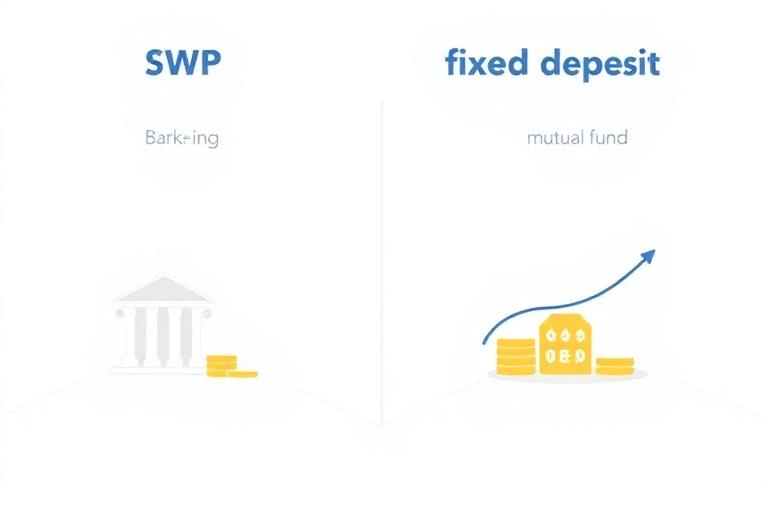
When planning for regular income, especially in retirement, two popular options emerge: Systematic Withdrawal Plans (SWP) from mutual funds and Fixed Deposits (FD) from banks. Both generate periodic income, but they work very differently in terms of returns, taxation, and risk.
How FD income works
A fixed deposit locks your money for a set period at a guaranteed interest rate. Interest can be paid monthly, quarterly, or at maturity. Current FD rates in India range 6 to 7.5% for most banks. The principal is protected (up to ₹5 lakh per bank under DICGC insurance).
How SWP income works
An SWP from a mutual fund lets you withdraw a fixed amount regularly while the remaining corpus stays invested and earns returns linked to the market. Historical equity mutual fund returns in India average 10 to 14% annually, though with volatility from year to year. Calculate your projected income with our SWP Calculator.
Returns comparison
Taxation: SWP has an edge
FD interest is fully taxable at your income tax slab rate. SWP withdrawals from equity funds held over 1 year are taxed as long term capital gains at 10% (above ₹1 lakh/year), which is significantly lower for most retirees. This tax efficiency makes SWP more attractive for higher tax brackets.
Risk considerations
- FD: Zero market risk, but inflation risk, since real returns may be negative after tax and inflation.
- SWP: Market risk exists, but diversified equity funds have historically outperformed inflation over 7+ year periods.
- Hybrid approach: Use FDs for 2 to 3 years of expenses and SWP for long term income.
Conclusion
Neither SWP nor FD is universally better. It depends on your risk tolerance, tax bracket, and income needs. For most retirees with a 15+ year horizon, a combination works best: FDs for short term safety and SWP for long term growth and tax efficiency. Use our SWP Calculator and Compound Interest Calculator to model both scenarios.
FAQ
Is SWP riskier than FD?
Which is more tax efficient: SWP or FD?
Can I use both SWP and FD together?
What happens to SWP during a market crash?
Next step
Use the calculators to model your scenario with consistent assumptions, then compare outcomes across time horizons and contribution plans.